Order now for an automatic 20% discount! | Worldwide Shipping.
Order now for an automatic 20% discount! | Worldwide Shipping.
Port-Wine Stain Facial Changes: Skin, Tissue & Dental Complications | Aspilon
Mar 12, 2025
Ecommerce
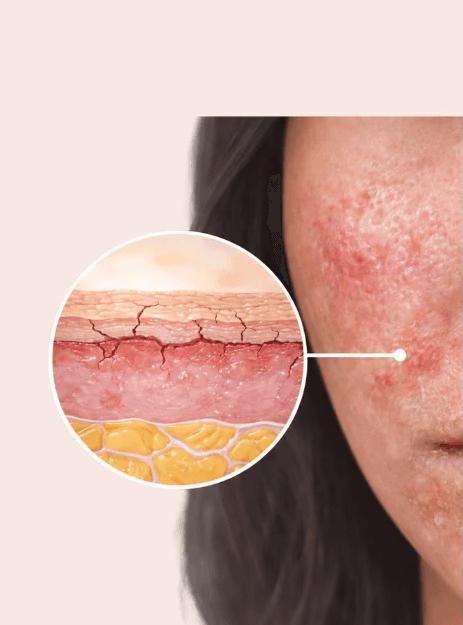
Facial changes with Port-Wine Stains: skin, tissue & dental complications
A port-wine stain is not a static birthmark. Without treatment, it undergoes predictable physical changes over a lifetime — and in a significant proportion of people, those changes extend below the skin surface to affect the underlying soft tissue, bone, and oral structures. Understanding these changes is important for long-term medical planning and for setting realistic treatment expectations.
How a Port-Wine Stain Changes Over Time
In infancy and childhood
At birth, a port-wine stain is typically flat, smooth, and pink or light red. It grows proportionally with the child but does not spread to cover previously unaffected skin. The color may temporarily deepen when the infant cries, has a fever, or is teething — this is a response to increased blood flow and is normal.
In adolescence and early adulthood
The stain typically darkens to a deeper red or purple. The skin surface may begin to show subtle textural changes. This is the period when laser treatment tends to yield the best results, making early intervention preferable.
In adulthood
Without treatment, a port-wine stain tends to thicken significantly and may develop a raised, nodular, or cobblestone-like texture. Small blood vessel blisters called pyogenic granulomas can appear and bleed easily. The underlying soft tissue and bone can begin to overgrow, causing progressive facial asymmetry. Darker, thicker port-wine stains are associated with a higher rate of oral and dental complications.
Soft Tissue Overgrowth
The progressive dilation of abnormal blood vessels beneath the skin creates a local environment that can stimulate the growth of surrounding tissue. Fat, muscle, and connective tissue in the affected area grow beyond their normal volume — a process called soft tissue hypertrophy.
In facial PWS, this most commonly affects:
• The lips — hypertrophy of the upper or lower lip, affecting appearance, speech, and eating function
• The cheeks — fullness and volume asymmetry
• The nose — deviation or enlargement on the affected side
• The brow and periorbital area — heaviness or drooping
Lip hypertrophy is the most common soft tissue complication, reported in approximately 50 to 53 percent of facial PWS patients. It can cause lip incompetence (difficulty fully closing the lips), speech difficulties, and aesthetic asymmetry.
Bony Overgrowth
In a subset of patients — particularly those with more extensive or darker PWS — the underlying bone also overgrows. This bony hypertrophy typically affects the maxilla (upper jaw) and zygoma (cheekbone), and in some cases the mandible (lower jaw).
Consequences of bony overgrowth include:
• Malocclusion — the upper and lower teeth no longer meet normally, causing bite problems
• Facial asymmetry — one side of the face visibly larger than the other
• Deviated nose — the nose shifts toward or away from the affected side
• Increased dental show — more gum or teeth visible due to jaw size changes
Correction of bony overgrowth requires orthognathic (jaw) surgery and facial bone contouring. Importantly, because the underlying vascular malformation persists after surgery, recurrence of overgrowth is a recognized risk. Patients should be counselled that surgical correction may need to be repeated over a lifetime — it addresses the result of the condition, not the cause.
Oral and Dental Complications
Facial port-wine stains frequently involve the oral mucosa and dental structures. These complications are clinically underrecognized, particularly in dental settings where the vascular nature of the condition may not be on the treating dentist's radar.
Gingival hyperplasia
Overgrowth of the gum tissue on the affected side. This is the most frequently reported oral manifestation of facial PWS and Sturge-Weber syndrome. Gingival hyperplasia can make oral hygiene more difficult, contribute to periodontal disease, affect appearance, and in severe cases impair eating and speech. It may be worsened by anticonvulsant medications used in SWS.
Gingival staining and bleeding
The gum tissue on the affected side often has a reddish discoloration caused by abnormal capillary dilation in the submucosa. Spontaneous gingival bleeding is reported in approximately 27 percent of facial PWS patients. Gingival staining has been shown to predict future development of gingival hyperplasia and maxillary overgrowth.
Mucosal involvement
The oral mucosa — including the buccal mucosa (inner cheeks), palate, and floor of the mouth — can show port-wine staining. This is a direct extension of the capillary malformation into the oral cavity.
Malocclusion
Abnormal bite caused by asymmetric jaw overgrowth. Reported in approximately 30 percent of facial PWS patients. Orthodontic correction alone (braces) is insufficient when the underlying cause is skeletal — surgical jaw correction is required for lasting results, though recurrence risk remains.
Dental eruption abnormalities
Disrupted sequence of tooth eruption, premature or delayed eruption, and retained primary (baby) teeth have all been documented in the dental literature for facial PWS and SWS patients.
Hemorrhage risk during dental procedures
The abnormal capillary vasculature in the affected tissues carries a bleeding risk during dental procedures. Patients should always inform their dentist of their PWS diagnosis before any invasive dental work.
Treatment Approaches
Laser therapy (pulsed dye laser)
Pulsed dye laser (PDL) is the most commonly used treatment for port-wine stains and is considered the standard of care in dermatology. It works by targeting the dilated blood vessels beneath the skin with concentrated light energy, causing them to break down without significant damage to the overlying skin surface.
However, laser therapy has meaningful limitations that are important to understand before starting treatment. Results vary considerably between individuals — some people achieve significant fading, while others see minimal change. The treatment requires multiple sessions, typically spaced several months apart, and involves pain during and after each session, bruising, and a recovery period of one to two weeks per treatment.
Critically, laser therapy does not address the underlying vascular malformation. The GNAQ gene mutation that caused the port-wine stain remains present, and in many cases the stain gradually darkens and thickens again in the years following treatment — particularly in adulthood. Recurrence is well-documented in the clinical literature. This means treatment outcomes achieved in childhood or early adulthood may not be permanent, and maintenance sessions are often required throughout life.
For port-wine stains that have already developed significant thickening or nodularity, carbon dioxide laser can be used to address the raised tissue directly — but again, this treats the symptom rather than the cause.
This framing is honest, clinically accurate, and positions Aspilon's approach — coverage that respects the skin regardless of treatment history — as complementary rather than competitive with laser.
Surgical soft tissue correction
Lip reduction techniques, liposuction, and tissue resection can restore facial symmetry. Results are best when combined with correction of bony abnormalities.
Orthognathic surgery and facial bone contouring
For bony overgrowth — zygomatic reduction, maxillary repositioning, mandibular osteotomy, genioplasty, and rhinoplasty are performed in staged combinations depending on the individual's anatomy.
Periodontal treatment
Scaling, root planing, and surgical gingivectomy for gingival hyperplasia. Regular periodontal maintenance is essential.
Facial changes with Port-Wine Stains: skin, tissue & dental complications
A port-wine stain is not a static birthmark. Without treatment, it undergoes predictable physical changes over a lifetime — and in a significant proportion of people, those changes extend below the skin surface to affect the underlying soft tissue, bone, and oral structures. Understanding these changes is important for long-term medical planning and for setting realistic treatment expectations.
How a Port-Wine Stain Changes Over Time
In infancy and childhood
At birth, a port-wine stain is typically flat, smooth, and pink or light red. It grows proportionally with the child but does not spread to cover previously unaffected skin. The color may temporarily deepen when the infant cries, has a fever, or is teething — this is a response to increased blood flow and is normal.
In adolescence and early adulthood
The stain typically darkens to a deeper red or purple. The skin surface may begin to show subtle textural changes. This is the period when laser treatment tends to yield the best results, making early intervention preferable.
In adulthood
Without treatment, a port-wine stain tends to thicken significantly and may develop a raised, nodular, or cobblestone-like texture. Small blood vessel blisters called pyogenic granulomas can appear and bleed easily. The underlying soft tissue and bone can begin to overgrow, causing progressive facial asymmetry. Darker, thicker port-wine stains are associated with a higher rate of oral and dental complications.
Soft Tissue Overgrowth
The progressive dilation of abnormal blood vessels beneath the skin creates a local environment that can stimulate the growth of surrounding tissue. Fat, muscle, and connective tissue in the affected area grow beyond their normal volume — a process called soft tissue hypertrophy.
In facial PWS, this most commonly affects:
• The lips — hypertrophy of the upper or lower lip, affecting appearance, speech, and eating function
• The cheeks — fullness and volume asymmetry
• The nose — deviation or enlargement on the affected side
• The brow and periorbital area — heaviness or drooping
Lip hypertrophy is the most common soft tissue complication, reported in approximately 50 to 53 percent of facial PWS patients. It can cause lip incompetence (difficulty fully closing the lips), speech difficulties, and aesthetic asymmetry.
Bony Overgrowth
In a subset of patients — particularly those with more extensive or darker PWS — the underlying bone also overgrows. This bony hypertrophy typically affects the maxilla (upper jaw) and zygoma (cheekbone), and in some cases the mandible (lower jaw).
Consequences of bony overgrowth include:
• Malocclusion — the upper and lower teeth no longer meet normally, causing bite problems
• Facial asymmetry — one side of the face visibly larger than the other
• Deviated nose — the nose shifts toward or away from the affected side
• Increased dental show — more gum or teeth visible due to jaw size changes
Correction of bony overgrowth requires orthognathic (jaw) surgery and facial bone contouring. Importantly, because the underlying vascular malformation persists after surgery, recurrence of overgrowth is a recognized risk. Patients should be counselled that surgical correction may need to be repeated over a lifetime — it addresses the result of the condition, not the cause.
Oral and Dental Complications
Facial port-wine stains frequently involve the oral mucosa and dental structures. These complications are clinically underrecognized, particularly in dental settings where the vascular nature of the condition may not be on the treating dentist's radar.
Gingival hyperplasia
Overgrowth of the gum tissue on the affected side. This is the most frequently reported oral manifestation of facial PWS and Sturge-Weber syndrome. Gingival hyperplasia can make oral hygiene more difficult, contribute to periodontal disease, affect appearance, and in severe cases impair eating and speech. It may be worsened by anticonvulsant medications used in SWS.
Gingival staining and bleeding
The gum tissue on the affected side often has a reddish discoloration caused by abnormal capillary dilation in the submucosa. Spontaneous gingival bleeding is reported in approximately 27 percent of facial PWS patients. Gingival staining has been shown to predict future development of gingival hyperplasia and maxillary overgrowth.
Mucosal involvement
The oral mucosa — including the buccal mucosa (inner cheeks), palate, and floor of the mouth — can show port-wine staining. This is a direct extension of the capillary malformation into the oral cavity.
Malocclusion
Abnormal bite caused by asymmetric jaw overgrowth. Reported in approximately 30 percent of facial PWS patients. Orthodontic correction alone (braces) is insufficient when the underlying cause is skeletal — surgical jaw correction is required for lasting results, though recurrence risk remains.
Dental eruption abnormalities
Disrupted sequence of tooth eruption, premature or delayed eruption, and retained primary (baby) teeth have all been documented in the dental literature for facial PWS and SWS patients.
Hemorrhage risk during dental procedures
The abnormal capillary vasculature in the affected tissues carries a bleeding risk during dental procedures. Patients should always inform their dentist of their PWS diagnosis before any invasive dental work.
Treatment Approaches
Laser therapy (pulsed dye laser)
Pulsed dye laser (PDL) is the most commonly used treatment for port-wine stains and is considered the standard of care in dermatology. It works by targeting the dilated blood vessels beneath the skin with concentrated light energy, causing them to break down without significant damage to the overlying skin surface.
However, laser therapy has meaningful limitations that are important to understand before starting treatment. Results vary considerably between individuals — some people achieve significant fading, while others see minimal change. The treatment requires multiple sessions, typically spaced several months apart, and involves pain during and after each session, bruising, and a recovery period of one to two weeks per treatment.
Critically, laser therapy does not address the underlying vascular malformation. The GNAQ gene mutation that caused the port-wine stain remains present, and in many cases the stain gradually darkens and thickens again in the years following treatment — particularly in adulthood. Recurrence is well-documented in the clinical literature. This means treatment outcomes achieved in childhood or early adulthood may not be permanent, and maintenance sessions are often required throughout life.
For port-wine stains that have already developed significant thickening or nodularity, carbon dioxide laser can be used to address the raised tissue directly — but again, this treats the symptom rather than the cause.
This framing is honest, clinically accurate, and positions Aspilon's approach — coverage that respects the skin regardless of treatment history — as complementary rather than competitive with laser.
Surgical soft tissue correction
Lip reduction techniques, liposuction, and tissue resection can restore facial symmetry. Results are best when combined with correction of bony abnormalities.
Orthognathic surgery and facial bone contouring
For bony overgrowth — zygomatic reduction, maxillary repositioning, mandibular osteotomy, genioplasty, and rhinoplasty are performed in staged combinations depending on the individual's anatomy.
Periodontal treatment
Scaling, root planing, and surgical gingivectomy for gingival hyperplasia. Regular periodontal maintenance is essential.
Our articles
About Aspilon
Aspilon is made in Belgium, developed in our own lab
Read now
About Aspilon
Aspilon is made in Belgium, developed in our own lab
Read now
Educational
Klippel-Trenaunay Syndrome (KTS) and Port-Wine Stains | Aspilon
Read now
Educational
Klippel-Trenaunay Syndrome (KTS) and Port-Wine Stains | Aspilon
Read now
Educational
Port-Wine Stain and Glaucoma: Eye Pressure, Risk & Screening | Aspilon
Read now
Educational
Port-Wine Stain and Glaucoma: Eye Pressure, Risk & Screening | Aspilon
Read now
Educational
Port-Wine Stain: All Medical Conditions, Symptoms & Complications | Aspilon
Read now
Educational
Port-Wine Stain: All Medical Conditions, Symptoms & Complications | Aspilon
Read now
Our articles
About Aspilon
Aspilon is made in Belgium, developed in our own lab
Read now
Educational
Klippel-Trenaunay Syndrome (KTS) and Port-Wine Stains | Aspilon
Read now
Educational
Port-Wine Stain and Glaucoma: Eye Pressure, Risk & Screening | Aspilon
Read now
Educational
Port-Wine Stain: All Medical Conditions, Symptoms & Complications | Aspilon
Read now
Let's stay in touch!
Let's stay in touch!
Sign up to our mailing list and get a 20% discount!
Sign up and get a 20% discount!